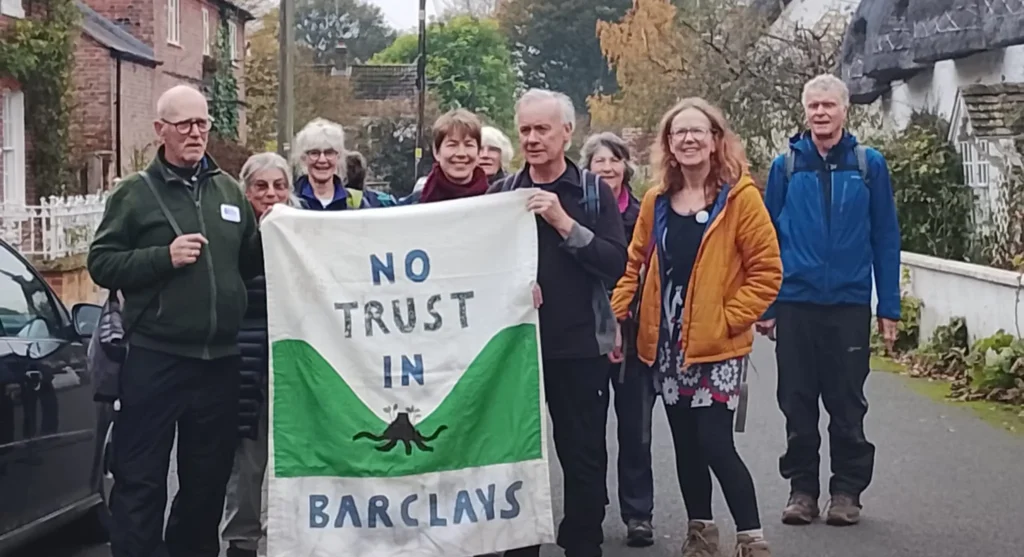
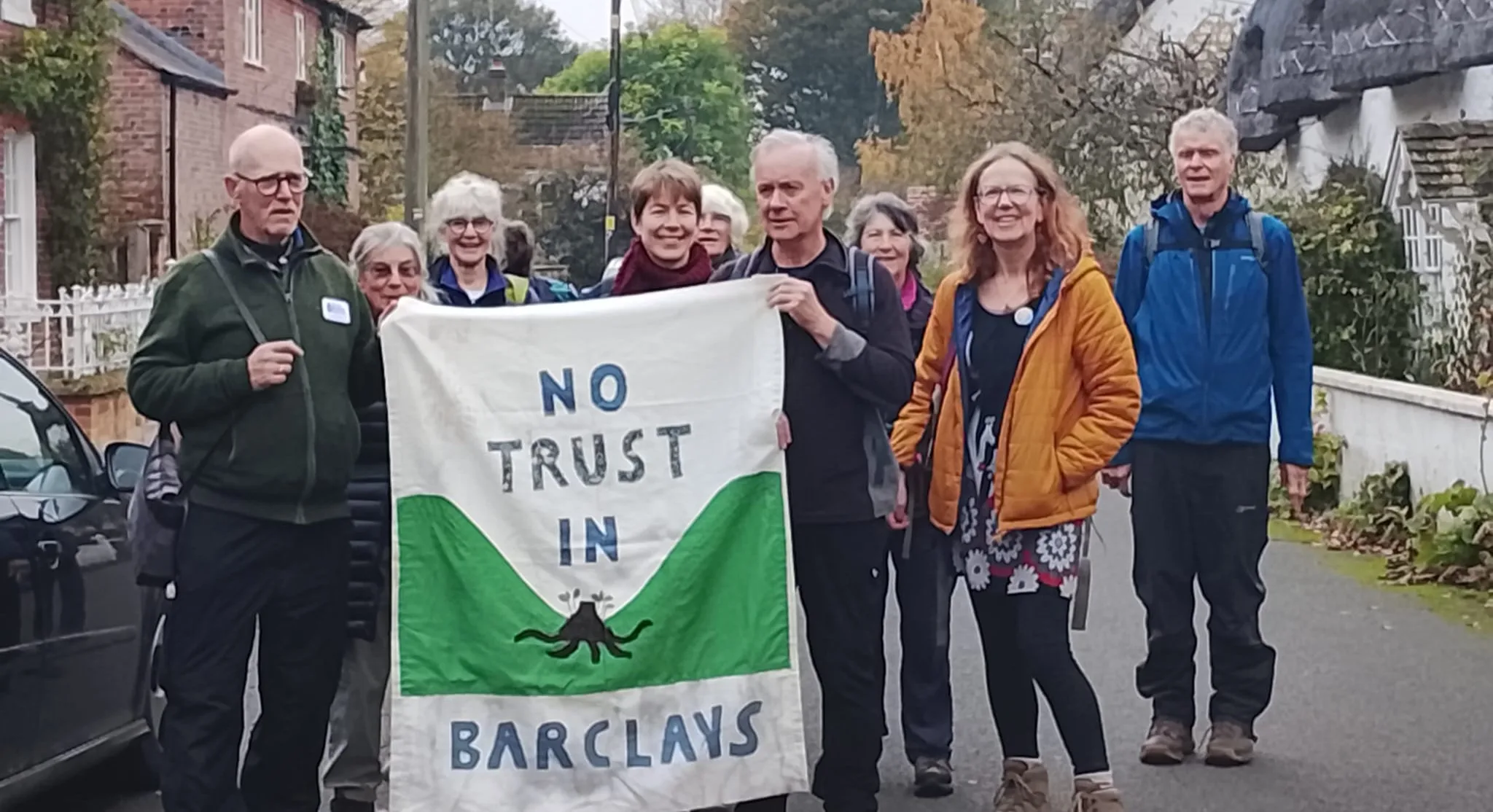
By Drew James and Annette James, Green Christian and Christian Climate Action Campaigners
Barclays consistently puts more money into planet-heating fossil fuels than any other bank in Europe, yet many respected charities, such as the National Trust, have continued to bank with Barclays; this despite the fact that by financing fossil fuels, Barclays is often working against these charities’ aims and environmental stances.
However, earlier this month at the National Trust’s Annual Meeting, it was declared that the ‘National Trust votes to seek banking partner more in tune with its environmental policies’, paving the way for this influential charity to switch banks.
How was this incredible result achieved?
Christian Climate Action has been campaigning on this issue since 2022, when, after taking disruptive action at Barclays’ AGM, we sought to effect change by way of boycott, noting that the bank’s annual report counts reputational damage as a ‘climate risk’. It was obvious that charity banking relationships with Barclays enhanced its brand and would be a matter of concern to many people.
In an address to Heartedge delegates in October 2026, the Revd Dr Sam Wells explored the relationship between ‘Goodness, Truth and Beauty’, encouraging us to see these not as competing priorities, but as different expressions of the same Gospel reality, all of which come together in Jesus.
We believe these three things also came together in our campaign for the National Trust to quit Barclays which is primarily an investment bank that channels billions into fossil-fuel expansion via corporate loans, revolving credit and the sale of bonds.
Alternatively, as Europe’s largest conservation charity with 5.5 million members, the National Trust has long declared climate change and the depletion of nature to be the greatest challenge it faces. Its trustees removed investments from fossil fuels in 2019, and so a focus on Barclays’ activities was likely to attract a sympathetic ear.
A plan came together during an Oxfordshire walk with Christian Climate Action colleagues and allies. This was to express love for how the National Trust cares for its lands and properties, but not for the emissions financed by Barclays. We would seek change by proposing a resolution at the Trust’s AGM in November 2022.
Membership networks like Operation Noah and Green Christian helped gather the 50 supporters needed to propose our resolution, all done within weeks. It was expressed in the form of an ultimatum, declaring that the National Trust would quit Barclays if the bank failed to end support for fossil fuels in the energy/ power sectors.
We had to think creatively as this would be a complex and multi-faceted process, with tactics to match. From the outset we maximised the assets of our broad network to open dialogue, undertaking the following actions:
- a church sewing circle in Surrey crocheted brooches of acorns and oak leaves in the style of the NT logo
- supporters from around the country researched National Trust trustees and embroidered table napkins with designs illustrating their interests
- One supporter took inspiration from a Shakespearean sonnet, writing in beautiful calligraphy, ‘I know a bank where the wild thyme grows…’
These items were packaged in an eco-friendly way and handed to each trustee early on the day of the AGM as a message of care and serious intent. This use of craft and action (sometimes called ‘craftivism’) resulted in the trustees seeking us out for conversation during lunch and tea breaks.
We learnt during this time that trustees had also been targeted by Restore Trust, a well-financed ‘culture wars’ group which contrived to define the National Trust as being ‘woke’ in matters where honesty and common decency had prevailed. In contrast, our challenging resolution was executed with respect and in good spirit.
The resolution proposed that year failed to get a majority, but we left with an assurance that an ongoing conversation was welcome. Aside from that, we were thanked by management for being a catalyst for Barclays and were invited to engage with its sustainability team, an exercise which ultimately proved to be fruitless.
Under National Trust governance rules, we could not repeat a banking resolution until 2026, but a dialogue was maintained throughout the intervening years, during which time we provided bi-annual updates to the National Trust’s finance officers, but also did much more as we continued to engage with the charity.
In 2024, we proposed a resolution for the National Trust to direct greater resources towards climate mitigation and adaptation. This happened to fit with the trustees new 10-year strategy and helped build trust and confidence that we were sincere in our care for the land and its biodiversity. The resolution was supported by the trustees and overwhelmingly supported by the membership. It also presented an opportunity to count withdrawal from Barclays as a facet of climate mitigation.
Over these years we also supported an AGM for more plant-based foods in National Trust cafes, engaged with National Trust staff and volunteers as part of a ‘Restore Nature Now’ march, supported an AGM resolution for the National Trust to back the proposed Climate and Nature bill and much more.
Finally, at the AGM on 7 November 2026, we were delighted that our resolution* was supported by the trustees and overwhelmingly by members. Afterwards we gave each of the trustees and finance officers an embroidered hankie, ‘Don’t Blow it’.
This result sends a strong message to the banking sector that civil society will not be party to the depletion of nature and the collapse of agriculture. We continue to visit National Trust properties and engage with staff, volunteers and members, always sharing our campaign and listening to their voices. The journey continues while we await the outcome of the tendering process, which may take a year or two.
*2026 Resolution: ‘This meeting demands that the trustees instruct our finance officers to begin a competitive tendering process for banking arrangements as soon as practicable. The criteria used must seek a bank which has a moral and ethical outlook in keeping with National Trust core values, and whose corporate lending and underwriting practices demonstrate a positive commitment to safeguarding biodiversity and reducing human induced climate change.’