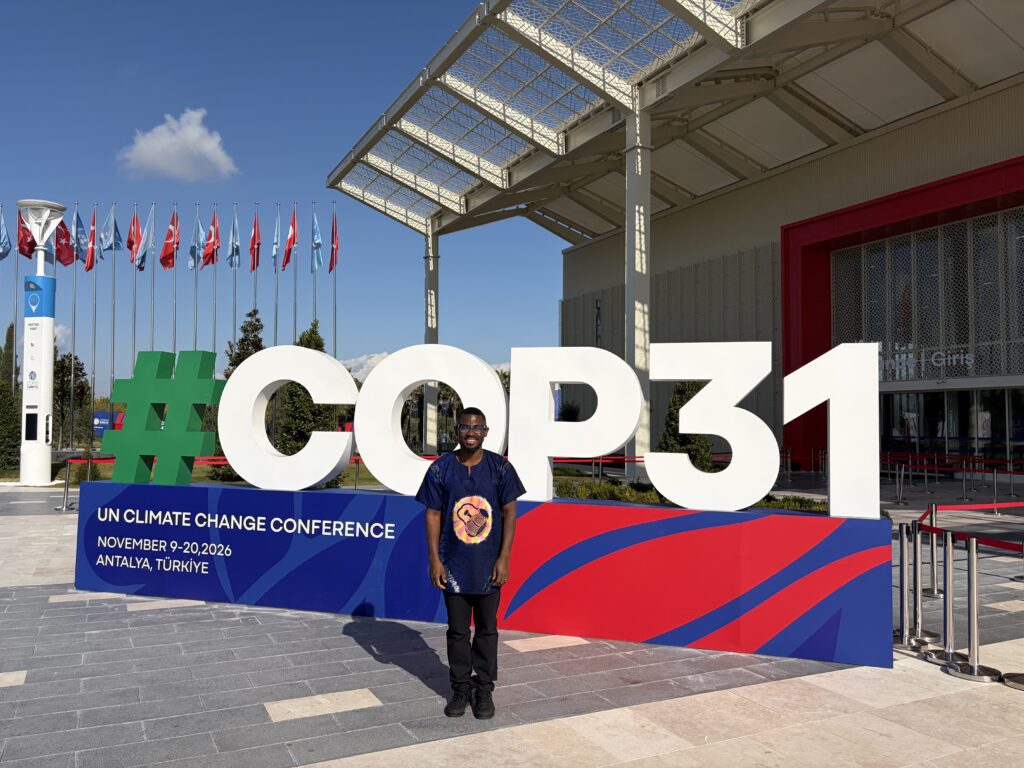
Dr Temitope Tunbi Onifade, a lecturer at Bristol University, attended COP31. Temitope is a legal scholar who took the time to answer our questions about the conference.
Operation Noah: Firstly, can you tell us a little of your focus within the negotiations, as an Environmental Law and Sustainability specialist at Bristol University? What specifically were you hoping for from these talks, and what has been achieved?
Dr Temitope Tunbi Onifade: ‘I went to COP31 as a delegate of the University of Bristol, as part of my affiliation with the Cabot Institute for the Environment and the Law School, where I co-direct our centre for Environmental Law and Sustainability.’
‘During my time at this mega conference, I focused on the high-level talks of world leaders, official negotiations and events, and side events relating to climate justice, energy transition and sustainable finance.’
‘These are the areas I study in my research, looking at the interactions and mixes of Indigenous and Western values and worldviews, state and non-state actors such as businesses and churches, and global and local players and systems. More specifically, I collected some participant observation data to use for research and gave some talks. I also granted media interviews, including to BBC London and TVC News in Nigeria, sharing my expertise and critiquing key highlights of COP 31.’
Operation Noah: Secondly, some campaigners have all but given up on the COP process due to the ways in which the conference has been influenced by fossil fuel lobbyists and petrostates – in fact, an alternative Climate Conference on Transitioning away from Fossil Fuels was established earlier this year in Santa Marta, Columbia. What has your experience been of the COP process? Do you still have hope in the promise of an international treatise?
Dr Temitope Tunbi Onifade: ‘Without the global climate law under which the COP process runs, we wouldn’t be where we are. Studies have already shown that governments have reduced greenhouse gases disrupting our climate system in ways that avoid the worst-case scenario, and this is partly because the COP process has given them an opportunity to talk to, learn from and compete with one another.’
‘But we need all the help we can get. The Santa Marta process is especially useful because it can get ambitious countries to phase out fossil fuels faster and bring in marginalized voices into global decision-making. The COP process centres governments in decision-making, which means some of the actors most disproportionately impacted by climate change, such as Indigenous Peoples, local and low-income communities, countries in Africa and other developing regions, and so on, do not contribute to its decision-making. The Santa Marta process can mitigate this. Yet it works with the COP process and is therefore inadequate on its own.’
Operation Noah: Thirdly, there was a significant Christian presence at COP31. What can you tell us about your experience connecting with other Christians or faith groups at the conference?
Dr Temitope Tunbi Onifade: ‘It was a pleasant surprise to learn about the vibrant Christian community at COP 31! I have attended previous COPs and did not see a similar level of participation, although this might also be because I didn’t pay close attention. I connected with Anglicans at COP 31, including on WhatsApp, and the Interfaith Liaison Committee, following developments on an app called Signal.’
‘I talked to people in these communities, including Rachel Mash who followed the conference remotely, and Simon Chambers, who I met in-person, and attended events and panels where Christians were represented.’
‘What stood out for me was realising the arguments I make in my research on climate justice, energy transition and sustainable finance align with those of faith communities. As I have written in my publications, climate justice is a framework of ideas for thinking about the responsibility for and implications of climate change, impacts, and actions, including within the energy transition and sustainable finance issue areas.’
‘The Christian community at COP 31 emphasised human responsibility for climate change, disproportionate impacts on marginalised communities and the more-than-human, and the responsibility of not only governments but also individuals to address such impacts in line with the stewardship of earth given to us by God.’
‘My biggest takeaway from my COP 31 observations is to pay closer attention to the role of faith in advancing climate justice. For instance, how might faith communities work with Indigenous Peoples, governments, industries and other communities to enhance our stewardship of the earth? Also, are there any areas of convergence and divergence in the faith and Indigenous approaches to such stewardship? These are interesting questions I hope to explore in future research.’